



If you wanted to acquire land in Upper Canada, there was a process or path to follow. The essential steps were the same, but depending on who you were, your particular circumstances, and where the land was situated, the path and the settler’s experience could be quite different.
The key to successful—and enjoyable—Crown land research is understanding the records as part of the process, created to document the acquisition of land by an individual, and to keep track of all those parcels of land and their distribution.
If you enjoy discovering clues and gathering evidence to find out who done it and where, you’ll love land records, and be able to envision the effort it took for your ancestors to get their land.
This post should give enough of a taste of the records to entice you to explore further—but it is nowhere near the full story. I don’t know the full story—but you can bet I’ll keep looking.
Understand your Township
Most Crown land records are identified by township rather than county. Before you plunge in, take some time to explore maps and maybe a bit of local history about your township. There are almost 400 townships in Ontario and they are all different. Here are a few resources to help you get to know your township.
- Canadian County Atlas Digital Project
- Patent plans, RG 1-100 at Archives of Ontario (unfortunately high-resolution scans are not available at present)
- Local libraries and archives
- Local municipality websites
- Digital Archive Ontario
- Wikipedia
- I’ve also written a post about Identifying Ontario’s lots and concessions.

The Basic Steps to Acquire Land in Upper Canada
- The prospective settler writes a petition requesting land.
- He or she submits the petition to the current land granting authority.
- The authority records the request and their decision, in the minutes.
- If yes, a warrant/ fiat/ order-in-council (OC) is given to the petitioner/grantee.
- The grantee obtains a “location” from the surveyor’s office and pays required fees.
- Settlement duties are performed and certified with a time limit.
- The grantee can then apply for the patent.
Records were created, and survive, around each of these steps.
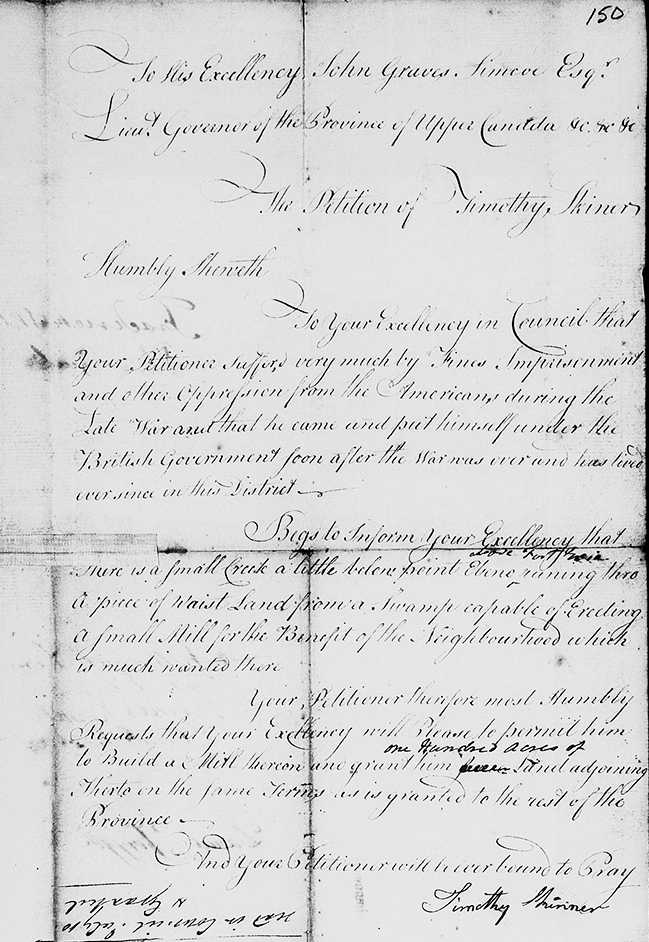
Petitions
At a minimum, a petition will contain the name of the petitioner and where they are writing from (not necessarily where they wanted or were granted land) and a date. It will also include a request for land, sometimes in a specific area or for a particular amount. The petitioner will also state why they deserve a grant—this part can provide great genealogical details. Supporting letters and affidavits are often attached. The petition and supporting documents were folded together, and salient details written on the outside or “jacket”. The jacket notes show the trail through the red tape.
The main collection of Upper Canada Land Petitions is at Library and Archives Canada (LAC) in Ottawa. The petitions are indexed by name here: bac-lac.gc.ca/eng/discover/land/land-petitions-upper-canada-1763-1865/. All of the information provided by the index, including year, volume, bundle, petition number, and microfilm number are important to locating the pages on the microfilm.

The microfilmed petitions have been digitized by LAC and also by FamilySearch.org. I find the FamilySearch versions easier to navigate and the inclusion of image adjustment tools can be invaluable.
- For the LAC petition films: See “How to obtain copies” on the search page.
- Here’s a link to the FamilySearch version: http://www.familysearch.org/search/catalog/521830
The LAC index to Upper Canada Land Petitions includes some petitions from the Upper Canada Sundries. The Sundries have been digitized at Heritage.Canadiana here: heritage.canadiana.ca/view/oocihm.lac_mikan_125539
There is an additional series of “Petitions relating to land received by the Crown Lands Department” RG 1-54-2 at the Archives of Ontario. The dates range from about 1827–1856 The petitions are not indexed, but arranged alphabetically by the surname of the petitioner. They have been microfilmed and are available by interloan from the AO. The same films have been digitized by FamilySearch here: https://www.familysearch.org/search/catalog/283269 (Petitions films are listed about halfway down the second page.)
Land Books
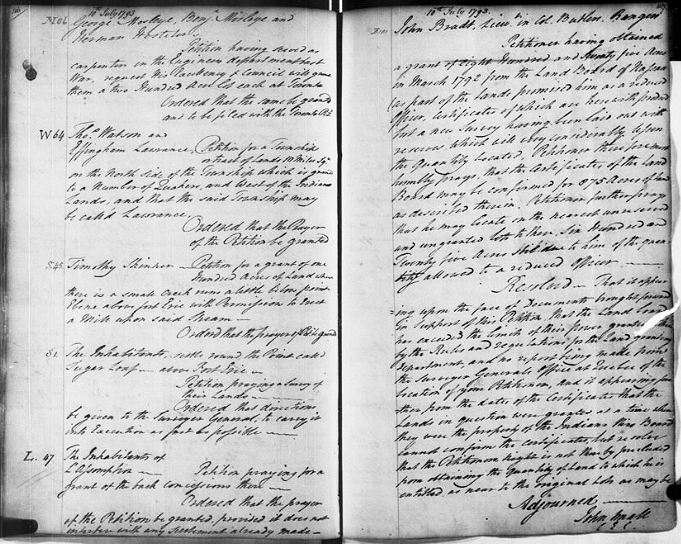
Land Books are the minutes of the land granting meetings of the Executive Council or Land Board. (I’ll refer to both as the Council.) They document the presentation of your ancestor’s petition to the Council and the Council’s decision.
Frequently the petition’s jacket (from the previous step) will record the Land Book volume (a letter) and a page number and you can use that to go directly to the Land Book.

The Land Books have also been indexed by volunteers from the Ontario Genealogical Society and the index is available in the OGS eStore in 10 digital volumes. Look for “Upper Canada Land Books Index” here: https://ogs.on.ca/product-category/society-items/ebooks-ontario-ancestors/
The Land Books are at LAC and have been digitized at Héritage.Canadiana.ca, however they are not well described and difficult to navigate. Please see this finding aid created by Toronto Branch member Irena Lewycka.
Other Documentation
If the Executive Council said yes, the petitioner/grantee was given proof called a warrant or fiat or order-in-council. All amounted to the same thing with different names. That piece of paper may or may not have survived, but a record of it probably does.
It was the grantee’s responsibility to get a “location” from the surveyor and to pay any required fees. (Even those who got free land might have to pay survey fees.) All those actions and payments generated records that may well survive.
The grantee could then go and settle on the land, but he didn’t quite own it. First he had to complete Settlement Duties. These varied with time and place, but he had to build a modest dwelling of a required size, clear a specified acreage, and help open and maintain the road in front of the property. Hard work. Didn’t always happen.
Once the Settlement Duties were done and certified (creating more records) the grantee could apply for the Patent. This final step was often misunderstood or ignored for various reasons. Life intervened.
A huge amount of this documentation has survived and is at the Archives of Ontario in RG 1 Crown Land Records.
- There are excellent finding aids for land records here: http://www.archives.gov.on.ca/en/access/research_guides.aspx#_Land_Records (At the time of writing, many of the links have not been updated to match the new AIMS database.)
- Much of RG 1 is available on interloan, and the AO’s interloan pages are a very useful finding aid themselves: http://www.archives.gov.on.ca/en/microfilm/crown_land_records_intro.aspx
- FamilySearch has also digitized many of the same microfilms and more are expected to be digitized. Find them here: https://www.familysearch.org/search/catalog/283269?
Some Other Documentation
Most of what we’ve looked at so far were records created by one individual’s quest for land. But lots of others were created to document and analyze the progress of distributing land and its settlement.
Officials wrote and received letters—so many letters.
Officials made lists to make their jobs easier and to appease their superiors. Lists of settlers by type—military, loyalists, pensioners, ethnic groups, etc. Lists by location—a township, along a river or road—or a specific time period. Lists of warrants, or locations, or settlement duty certificates. Financial records showing fees collected or outstanding. All of these lists included settlers’ names.
Most of the records survive and can be found in RG 1 at the AO. Many are also on FamilySearch. Use the finding aids mentioned in the section above.
It is only fair to warn you that this will involve some digging and persistence. But we’re genealogists and we love that sort of thing!
Be sure to read about Township Papers in the previous two posts.
5 thoughts on “Paths to a Patent: Acquiring Crown Land in Upper Canada”
Bless you!!!
No doubt about it. Land Records are very confusing but you have assisted greatly with this article about finding Patent procedures. This is a wonderful article and has been most helpful. I wish to subscribe to your Blogs. I will be looking at many of your past articles!! Thank you so very much for the time and effort that you expended on our behalf. Most helpful!!
Thanks, Roger, I’m glad you found it useful. To subscribe by email, use the subscribe box in the left sidebar (if you’re on a computer). If you’re reading this on a phone or tablet, scroll way down for the same subscribe box.
Jane
Another excellent article. I have been transcribing the land registry files for our township and have come across a lot of abbreviations that I do not understand. I have figured out some of them, for example “B & S” = “Bargain and Sale”, and “M” = “Mortgage” and “D M” = “Discharge of Mortgage” but some of the others are not so easy to figure out. Would on consider doing a blog on this subject, not only stating the meaning of the shorthand but also which items actually involve the transfer of the land.
Hi Roger. I’m glad you found the post useful. Thank you. For abbreviations, I highly recommend the book “Ontario Land Registry Office Records: A Guide” which has a good glossary and is available from Toronto Branch OGS here: https://torontofamilyhistory.shop/item/ontario-land-registry-office-records/. It sounds like the files you are transcribing are the abstract index books. Don’t forget that the instruments/documents listed can be consulted. Sometimes the abbreviations are unusual and/or scribbled–and you really need to look at the actual digitized document. (And there are treasures in the documents, too.)
Thank you, I already have the book on the list of books to order; I am just waiting to see if the local historical society wants a copy. It is the abstract index books that I am transcribing, and they contain a lot of interesting information, including much that the locals (I am not one) know about.
Roger